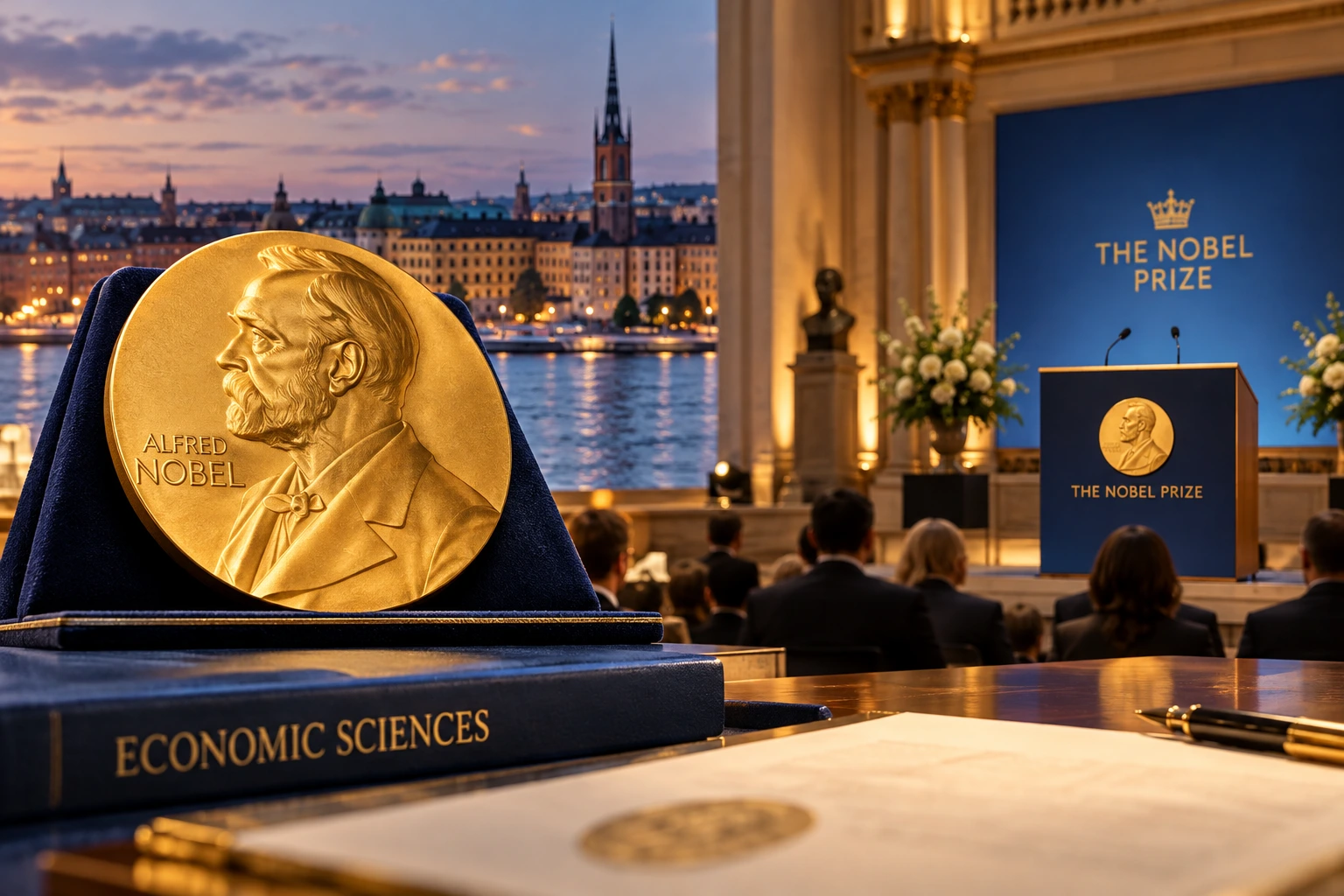
The Royal Swedish Academy of Sciences will name the winner or winners of the 2026 economics prize in Stockholm on Monday, the final announcement of this year's Nobel season. The award carries 12 million Swedish kronor, roughly $1.2 million, and the Academy is due to reveal its choice at 11:45 a.m. local time.
The honor closes a week that has already produced laureates in medicine, physics, chemistry, literature and peace. The economics prize arrives last by tradition, and it draws more attention from markets, universities and policymakers than most people expect from an academic award.
The purse is bigger this year. The Nobel Foundation lifted the prize amount for 2026, up from the 11 million kronor handed out in 2025. The money goes to a single laureate or is divided among a small group, depending on the Academy's decision.
A prize with an asterisk
Strictly speaking, the economics award is not one of Alfred Nobel's original prizes. Sweden's central bank created it in 1968 to honor the memory of the chemist and industrialist who invented dynamite and left his fortune to fund the five awards named in his will. Its formal title is the Sveriges Riksbank Prize in Economic Sciences in Memory of Alfred Nobel, and the first winners were chosen in 1969.
Nobel traditionalists still make the distinction. Yet the award is presented alongside the others at the Dec. 10 ceremony, held on the anniversary of Nobel's death in 1896, and carries the same medal and prize money. Through 2025 it had been given 57 times to 99 laureates.
Last year set a high bar
The 2025 prize went to Joel Mokyr, Philippe Aghion and Peter Howitt for explaining how innovation drives lasting economic growth. Mokyr was recognized for identifying the conditions that make sustained technological progress possible, while Aghion and Howitt were honored for a theory of growth built on creative destruction, the process by which new products and firms displace established ones.
That choice put the economics of business innovation squarely in the spotlight. This year's selection will show whether the Academy stays close to growth and technology or turns to another part of the discipline, such as labor markets, finance, trade or the economics of artificial intelligence.
Forecasters have few firm signals
Predicting the winner is notoriously hard. Academic commentators and prediction markets have floated names, including Stanford's Susan Athey and Paris-based Thomas Piketty, but trading on those markets has been thin and the Academy does not signal its leanings. Surprises are common.
Next checkpoint
What to watch
Whether the 2026 prize is shared or goes to one person, which field it rewards, and how the laureates respond to current debates over growth, inflation and technology.
Evidence
Sources and editorial notes
Reporting was checked against Associated Press coverage, the official NobelPrize.org announcement schedule and prize history, and additional coverage of the 2026 purse and prize-watching speculation. Forecasts are attributed as speculation, not confirmed outcomes.
- Associated Press — The Nobel memorial prize in economics is set to be awarded in StockholmOriginal reporting
- NobelPrize.org — All prizes in economic sciencesReference
- ARA — 2026 Nobel Prize in Economics: follow the announcement liveNews reporting
Spot an error? Read our corrections policy.