
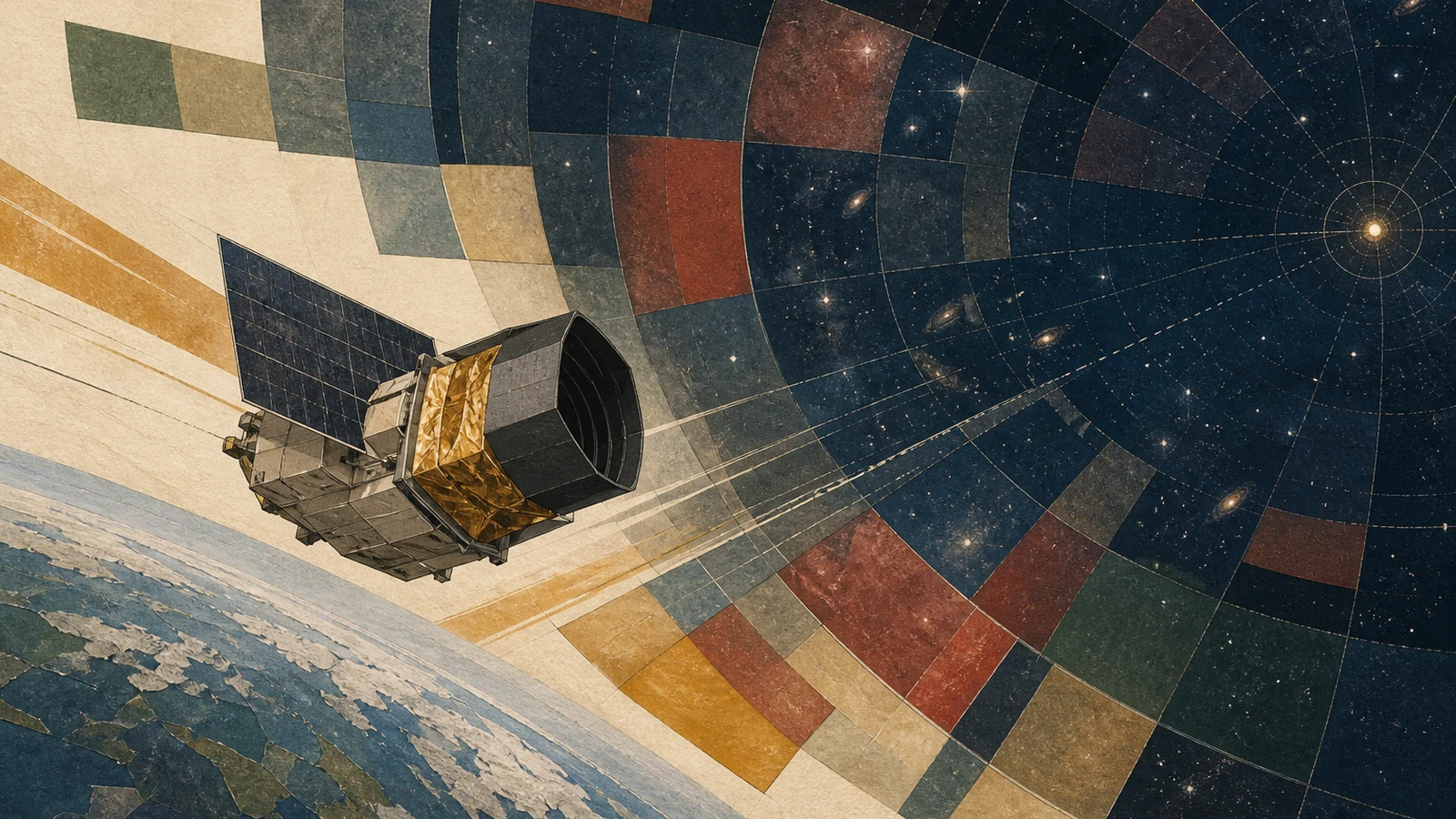
The rocket left Launch Complex 39A at Kennedy Space Center in Florida at 7:26 a.m. Eastern time, its 27 first-stage engines generating more than five million pounds of thrust. Roughly half an hour into the flight, the telescope separated from the rocket's upper stage and began the independent journey to its observing post nearly a million miles from Earth.
Named for Nancy Grace Roman, the astronomer often credited as the driving force behind the Hubble Space Telescope, the new observatory is built around the same size primary mirror as Hubble but carries a far wider view of the sky. NASA says Roman's field of vision is roughly 100 times larger than Hubble's, allowing it to survey vast stretches of the cosmos far more quickly than any previous space telescope.
Over its planned five-year mission, Roman is expected to capture light from hundreds of millions, and potentially more than a billion, galaxies. Scientists plan to use that data to sharpen our understanding of dark energy, the mysterious force thought to be accelerating the universe's expansion, and to conduct a systematic survey of planets orbiting stars beyond our solar system.
The mission's path to the launch pad was not entirely smooth. Earlier in the current administration's budget planning, funding for Roman was targeted for cancellation before lawmakers restored it, and the observatory ultimately reached the pad months ahead of its original schedule after NASA and its contractors completed construction and testing faster than planned.
“practically limitless opportunities for astronomers”
— NASA mission description
A Three-Month Journey
Roman will spend approximately three months traveling to its operating position at what's known as the second Lagrange point, a gravitationally stable spot far beyond the moon's orbit where the James Webb Space Telescope and other observatories also operate. Over the coming days, the spacecraft will unfold its solar panels, sunshade and antenna, and perform course corrections to refine its trajectory.
NASA Administrator Jared Isaacman joined mission scientists and engineers at a post-launch briefing, where officials described the telescope as functioning normally and tracking toward its intended orbit. Engineers will spend the coming weeks activating and calibrating Roman's instruments before regular science operations begin.
What Scientists Hope to Learn
Beyond its core dark energy and exoplanet research, Roman is designed to generate enormous volumes of publicly available imaging data, which NASA expects will fuel thousands of additional research projects that have not yet even been proposed. Because of the sheer scale of sky it can capture in a single exposure, astronomers describe Roman less as a telescope built to answer one question than as a survey instrument meant to open new ones.
The mission is a partnership between NASA's Goddard Space Flight Center, which built and will operate the observatory, and the Space Telescope Science Institute, which will manage its science program alongside the team already running Hubble and Webb.
Hunting for Planets and Rogue Worlds
One of Roman's signature projects will be a years-long survey of the crowded star fields near the center of the Milky Way, where the telescope's wide field of view and sensitivity to faint brightness changes will let it detect exoplanets using a technique called gravitational microlensing. That method can reveal planets that are too small, too distant, or in orbits too wide to be found by other detection methods, including free-floating planets that drift through the galaxy without an accompanying star.
Researchers expect the survey to substantially expand the known catalog of worlds beyond our solar system, complementing the smaller, closer-in planets found by earlier missions like Kepler and the Transiting Exoplanet Survey Satellite. Combined with a specialized coronagraph instrument designed to block out starlight and directly image planets in nearby systems, Roman gives astronomers new tools for studying not just how many planets exist, but what many of them might actually look like.
Following the Mission
NASA said it plans to release a steady stream of updates as Roman travels to its final orbit and begins commissioning its instruments, with first science images expected roughly six months after launch. Because so much of the telescope's data will be made publicly available shortly after it is collected, officials say they expect both professional astronomers and amateur researchers to comb through the archive for discoveries the mission's own science team never anticipated.
For a program that narrowly avoided cancellation just a few years ago, Sunday's successful launch was described by several NASA officials as a validation of the years of engineering work that went into getting Roman off the ground, and a reminder of how quickly a mission's fortunes can shift once hardware finally reaches the launch pad.
Next checkpoint
What to watch
Deployment milestones during the cruise to L2, instrument checkout and NASA's schedule for the first public science observations.
Evidence
Sources and editorial notes
This post was reviewed against the linked primary material and independent sources. Developing figures are labeled and may change.
Spot an error? Read our corrections policy.